Showing posts with label health information exchange. Show all posts

Saturday, May 8, 2010

Our employee meetings

As I do from time to time, I held ’round-the clock meetings for employees on May 6. Naturally, a lot of the discussion focused on the impact of the federal health care reform legislation as it affects hospitals, as well as on the status of Community General Hospital's merger discussions with Crouse Hospital.

Health care reform legislation

I summarized the effects of the health care reform legislation – admittedly, at a very high level – on consumers, hospitals, and other organizations. For consumers, health care coverage will become more available, and an estimated 30 million individuals could be added to insurance rolls. Individuals will not be excluded from purchasing health insurance because of pre-existing health conditions, nor will there be any lifetime caps on what insurance pays for care and treatment. Adult children, up to the age of 26, will be able to have coverage under their parents’ insurance plans. This information has been generally well-covered in the news media.

I also talked about the impact of health care reform legislation on hospitals, specifically about the $196 billion reduction in Medicare and Medicaid payments to hospitals over the next ten years. There will be new taxes on medical devices and on brand-name pharmaceuticals ($31 billion over ten years), as well as the new taxes on health insurance coverage itself ($57 billion during the period). These are examples of increased costs hospitals will have to pay for the goods and services they buy.

The hospital association has translated the $196 billion nationwide reduction into the impact on each hospital in New York State. Because of the new legislation, the four hospitals in Syracuse, NY, will receive $424 million less from Medicare and Medicaid over ten years. These are huge numbers, and they are hard to imagine in the current context.


These reductions in revenue are expected to be offset to some extent by revenue from individuals who will have health coverage, thanks to the legislation. It is very unlikely, however, that the revenue from the newly insured will come close to offsetting the reduced hospital payments that are forecast.

Overall the health care reform law will be a transformative force affecting the way health care is provided in our society.

Our merger talks

In this context I discussed the merger talks currently underway between Community General and Crouse Hospitals. I compared the forces acting on Community (such as, higher state taxes, the needs of physicians and medical groups, and pension costs) with some of the forces affecting Central New York generally (such as, flat population growth, an aging population, and Medicaid cutbacks). Recognizing these forces and anticipating the impact of federal health reform legislation, last January Community and Crouse entered an agreement to plan a merger, if feasible.

Moody’s, the financial analysis company, recently predicted that, as a result of federal legislation, non-for-profit hospitals will find it more difficult to borrow funds and that more hospitals will look for opportunities to consolidate.

Community and Crouse are, in fact, considering the advantages of creating a larger hospital that operates two campuses. The advantages could include the better ability to work with physicians, potentially better access to capital, more efficiency, and the ability to avoid duplicate investments. In interviews with consultants earlier this year, physicians from both hospitals suggested various ideas, and the consultants have been considering these. The consultants are getting close to a recommendation for both hospitals to consider.

Assuming both hospital boards adopt a structure recommended by the consultants, there will still be a number of steps remaining before the merger process is done. These include implementation planning with clinicians, filing a Hart Scott Rodino document with the Federal Trade Commission, and preparing a Certificate of Need (CON) application for New York State. In addition, both hospitals would have to complete “due diligence,” a process in which each hospital examines the other’s business in detail, considering such things as financial performance, business contracts, tax issues, pension obligations, property ownership, etc. The time frame for these activities could be another year or so.

Our financial performance

I also reviewed Community's financial performance through the first quarter of 2010.

I was pleased to report that through March, Community is operating in the black and on-budget (see the chart below). This is significantly better financial performance than we experienced in 2009 in the first quarter.

Patient satisfaction

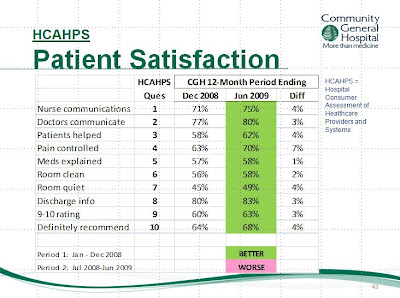
I discussed patient satisfaction and showed how Community's most recent HCAHPS scores – as self-reported by Medicare patients – have improved in every category.

The HCAHPS survey measures the percentage of Medicare patients who report that nurses and doctors “always” communicate well, that their pain is “always” well-controlled, and that their rooms are “always” well-cleaned. Community does well in comparison with other Syracuse hospitals – we have the highest scores in three of ten categories and the second highest scores in another five categories. And . . . Community's HCAHPS scores improved in the most recent 12-month period (see the chart, below).
Improvements to come

I talked about improvements being made to patient rooms on several units. The sixth floor renovation (orthopedics) has been completed, and room improvements are underway on Three West. Furthermore, we have begun to update rooms on Four West and, when finished in late summer, the patients and staff from Two West will relocate to Four West to take advantage of the updated and larger rooms. Following that, we will make improvements to the GYN rooms on Two East.

The new health information exchange

Community will become the first hospital in Syracuse this year to link to the health information exchange (HIE) being developed by the Health Advancement Collaborative of Central New York (HAC-CNY).

The HIE will initially link all four Syracuse hospitals, through the Internet, with five primary care physician groups, representing several hundred physicians. By next year doctors and hospitals on this fledgling network will be able to exchange patient-specific data with the consent of the patients themselves. As more physician practices join the exchange, HAC-CNY will link to other networks through the State Health Information Network of New York (SHIN-NY). The idea is to make individual patient information readily available to any of that individual’s caregivers. Naturally, there are demanding security and patient privacy requirements for this to function.

Employees had a number of questions and suggestions during the meetings, and I appreciated the opportunity to speak with so many of you.

Saturday, March 29, 2008

State grant to start health information exchange

Yesterday Governor David Patterson announced the award of $105 million to 19 health information exchange (HIE) projects across New York State. This includes an award for the HIE being planned for Onondaga County. The local grant will be announced Monday (March 31) at a press conference in which I will participate.

The project in Onondaga County[1] will join with one in Broome County to develop an electronic information exchange in Central New York that will make available patients’ radiology, laboratory, and prescription data among physician offices, laboratories, pharmacies and hospital emergency departments. A study showed that such an HIE has the potential to reduce medical errors, to reduce unnecessary tests, and to improve care delivery in Central New York.

A recent article in the Harvard Business Review (HBR)[2] called such regional health information organizations (or RHIOs) “a promising new type of health care organization,” but asked “can these new entities…survive?” A handful of RHIOs are currently working in the US, and there are “some 100 or 200 more in development.” A number of such organizations are starting in New York, thanks to seed money provided by state government under its HEAL[3] grant program.

RHIOs are important because, despite all the computers used in health care, patient health information systems do not talk with one another. The RHIO that is planned for Central New York would allow patient data, including test results and prescription information, to be available through the Internet among hospitals and medical offices.

If there are big advantages to RHIOs, there are also big obstacles, as I have discussed. RHIOs need large capital investments to get started. They require cooperation among hospitals, labs, doctors, public agencies. They must have systems for assuring confidentiality, and they must overcome the lack of industry-wide technical standards.[4]

The local sponsor[5] of the RHIO is working on a business plan that will use the savings generated by the exchange to fund its ongoing operating costs through health insurance companies. That means the health insurance companies, hospitals, and doctors business will all have to agree on the business plan and will all have to forge agreements with the RHIO to make it a reality.

Yesterday’s HEAL grant awards is a promising start for this project. But it is a beginning, not the end.

Those of us who provide health care – and those who pay for it – will have a lot more work to do to make such a health information exchange a reality. And now is the time to start.


[1] The Onondaga County project is sponsored by the Health Advancement Collaborative of Central New York, of which I am the Secretary.
[2] Adler-Milstein, Julie and Jha, Ashish, “Fledgling Firms Offer Hope on Health Costs,” Harvard Business Review, March 2008, pp. 26-28
[3] Health Care Efficiency and Affordability Law for New Yorkers (HEAL NY)
[4] Adler-Milstein and Jha.
[5] Health Advancement Collaborative of Central New York.

Saturday, November 17, 2007

Will we get a health information exchange?

On Monday Community General Hospital, along with other Syracuse hospitals,[1] will be part of a grant application that asks New York State for several million dollars to start a health information exchange (HIE) in Onondaga County. This will be our third such state application in as many years – and so far, our success rate is 0-2.

The HIE application will be submitted by the Health Advancement Collaborative of Central New York (HACCNY)[2] in cooperation with the Southern Tier Health Link, an organization that did receive a grant from the state under an earlier application process. Its success rate is 1-1.

An HIE would make patient data available via the Internet, no matter which doctor, hospital, or testing center holds a patient’s past test results. That means, any physician could, with a few keystrokes, locate an individual patient’s recent (or past) x-ray and lab results, as well as prescription lists, no matter what time of day or night…even on weekends. That could improve care, it could reduce waiting times, and it could save money by avoiding duplicate tests.

Some people assume that such ready access to patient data already exists, and they can’t believe that all the computers in the health care world don’t really talk to one another. But health care is filled with stand-alone systems for radiology, lab results, and medications. Even when the systems are linked, they typically do not communicate beyond the walls of a doctor’s office or hospital.

The advantages of health information exchange are self-evident. Bill Gates writes:
For the last thirty years computers and software have helped industry after industry eliminate errors and inefficiencies and achieve new levels of productivity and success. Many of the same concepts and approaches…can be adapted to the particular requirements of health care.
Dr. David Brailer, the former National Coordinator for Health Information Technology for the Bush Administration, said recently that the problem of linking patient data in a system wide exchange
is numbingly complex, and simplistic solutions won’t work. In an ideal world, we would not have to create intermediate infrastructure like [the exchange that HACCNY is trying to build] but in an ideal world HIT (health information technology) would already be in use.
Besides computer systems that don’t communicate with one another, there are other obstacles to developing an HIE, including paying for it. In the health care world, the sector that pays for an HIE investment doesn’t necessarily realize the benefits of such investment.

A 2006 a HACCNY study[3] demonstrated that potentially significant savings could be achieved by a Central New York HIE if it is structured to eliminate duplicative and unnecessary tests, reduce medication errors, and increase generic prescriptions. But that same study showed virtually all the savings from an HIE would accrue to insurance companies and the third parties that administer employer self-insured claims, not to doctors and hospitals that would have to pay for it or incur costs in implementing it.

In our health care world incentives are often misaligned, even perverse. If one part of the system benefits, another part is often if penalized, even when the overall impact on society is a positive one.

Of a potential $20 million in annual savings for CNY, 94% would go to the insurance side of health care. Other parts of the health care system – namely hospitals and pharmacies – would have negative savings. In other words, the HIE would actually cost hospitals and pharmacies more, not less. This argues for HIE investment by the sectors that realize the return from it, i.e., by insurance companies, by governments, or both.

To its credit, New York State has the HEAL grant program, under which tens of millions of dollars become available for doctors and hospitals to link together their patient data systems. The state realizes such linkage is in the long term interests of patients, and therefore it is in the public interest to capitalize HIEs with public funds.

HACCNY’s first grant application was turned down by New York State on a technicality. HACCNY did not yet have approval from the IRS for its tax-exempt status. This year the state declined to award funds because, after all the applications were submitted, Governor Spitzer’s administration changed the criteria developed by Governor Pataki’s administration. HACCNY’s second HIE application, along with all the others submitted in state, was turned down.

Next week HACCNY makes its third run at HEAL funds, this time in combination with doctors and hospitals from the Southern Tier. Let’s hope the third time is, as they say, the charm.

But even a successful grant award will not assure the start of an HIE in Onondaga County. There’s another obstacle, the lack of sustainability.

If HACCNY is successful in getting the hardware and software grant needed for an HIE, there is as yet no workable financial plan to assure the new system can pay its operating costs year after year. HACCNY wants to develop a sustainability plan, and it intends to accept state funds only when it has a viable financial model in place.

Stay tuned.


[1] Community General Hospital, Crouse Hospital, St. Joseph’s Hospital Health Center, and University Hospital of SUNY Upstate Medical University.

[2] I am the secretary of HACCNY, which is composed of health care, business, and insurance representatives. HACCNY was developed by the efforts of the MDA (Metropolitan Development Association), MACNY (Manufacturer’s Association of CNY), Greater Syracuse Chamber of Commerce, the Hospital Executive Council (HEC), the Onondaga County Medical Society, and Excellus BlueCross BlueShield.

[3] The study, funded by HACCNY and Excellus of CNY, was conducted by Health Alliant.

Saturday, June 4, 2005

EMR promise and reality

It was standing room only in the POB-South classroom at Community General Hospital on May 27 when several presenters discussed the promise – and the reality – of electronic medical records (EMRs). The forum was organized by health care advisers to New York State Assembly Member Jeff Brown (121st Assembly District).

Dr. David Wormuth, a thoracic surgeon, opened the discussion by reviewing office-based medical record systems, such as the one he uses. This was followed by a discussion of hospital EMRs by Mitch Rozonkiewiecz, CGH vice president of information technology, and Chuck Fennel who has the same position at St. Joseph’s Hospital.

Mitch talked about the importance of linking separate CGH systems (such as radiology, pharmacy, and patient access) through a common “portal” that is easier for clinicians to use and that improves patient safety by reducing multiple data entries and patient look-ups. He also talked about a discussion by the Manufacturers’ Association of Central New York (MACNY) about possibly forming a regional health information network (RHIO). A RHIO would permit physician offices and hospitals with EMRs to exchange test results and other patient information, no matter where in our region a patient had tests.

Such connectivity is the promise of electronic medical records, although the discussion quickly focused on some barriers to that promise.

Several physicians in attendance talked about the difficulty of using EMRs that include lengthy narrations or formulaic sentences, making it time consuming to locate relevant information about a patient. Chuck Fennell said that, despite all the talk about records portability, “the health care industry is underserved because commercial products are not readily available for implementation in community hospitals.” There are some 300 vendors who provide systems with differing components, making it difficult for medical practices to select a vendor or commit to the cost of a system that might not survive all the market and regulatroy changes to come.

Mitch Rozonkiewiecz said that forming a local RHIO would be a formidable undertaking requiring the community to provide the “brains, the investment, and the standards for use.” Where, he asked, would the necessary resources come from?

One person attending the forum was Nasir Ali, the Chamber of Commerce vice president responsible for new venture development. He said the health care system is not a single process – it acts more like an ecosystem. He speculated the lack of a single, large customer makes it difficult for the information technology industry to focus on a single standard for connectivity. Mr. Ali suggested that the formation of RHIOs might provide a sufficiently large customer base to help the information technology industry develop the systems and standards necessary for connectivity, similar to that of the internet.

It was a fascinating discussion, full of promise and caution in equal measure.

Assemblyman Brown deserves thanks for arranging such a briefing on this important subject, and CGH was pleased to serve as host for the meeting.