Showing posts with label health care reform. Show all posts

Saturday, May 8, 2010

Our employee meetings

As I do from time to time, I held ’round-the clock meetings for employees on May 6. Naturally, a lot of the discussion focused on the impact of the federal health care reform legislation as it affects hospitals, as well as on the status of Community General Hospital's merger discussions with Crouse Hospital.

Health care reform legislation

I summarized the effects of the health care reform legislation – admittedly, at a very high level – on consumers, hospitals, and other organizations. For consumers, health care coverage will become more available, and an estimated 30 million individuals could be added to insurance rolls. Individuals will not be excluded from purchasing health insurance because of pre-existing health conditions, nor will there be any lifetime caps on what insurance pays for care and treatment. Adult children, up to the age of 26, will be able to have coverage under their parents’ insurance plans. This information has been generally well-covered in the news media.

I also talked about the impact of health care reform legislation on hospitals, specifically about the $196 billion reduction in Medicare and Medicaid payments to hospitals over the next ten years. There will be new taxes on medical devices and on brand-name pharmaceuticals ($31 billion over ten years), as well as the new taxes on health insurance coverage itself ($57 billion during the period). These are examples of increased costs hospitals will have to pay for the goods and services they buy.

The hospital association has translated the $196 billion nationwide reduction into the impact on each hospital in New York State. Because of the new legislation, the four hospitals in Syracuse, NY, will receive $424 million less from Medicare and Medicaid over ten years. These are huge numbers, and they are hard to imagine in the current context.


These reductions in revenue are expected to be offset to some extent by revenue from individuals who will have health coverage, thanks to the legislation. It is very unlikely, however, that the revenue from the newly insured will come close to offsetting the reduced hospital payments that are forecast.

Overall the health care reform law will be a transformative force affecting the way health care is provided in our society.

Our merger talks

In this context I discussed the merger talks currently underway between Community General and Crouse Hospitals. I compared the forces acting on Community (such as, higher state taxes, the needs of physicians and medical groups, and pension costs) with some of the forces affecting Central New York generally (such as, flat population growth, an aging population, and Medicaid cutbacks). Recognizing these forces and anticipating the impact of federal health reform legislation, last January Community and Crouse entered an agreement to plan a merger, if feasible.

Moody’s, the financial analysis company, recently predicted that, as a result of federal legislation, non-for-profit hospitals will find it more difficult to borrow funds and that more hospitals will look for opportunities to consolidate.

Community and Crouse are, in fact, considering the advantages of creating a larger hospital that operates two campuses. The advantages could include the better ability to work with physicians, potentially better access to capital, more efficiency, and the ability to avoid duplicate investments. In interviews with consultants earlier this year, physicians from both hospitals suggested various ideas, and the consultants have been considering these. The consultants are getting close to a recommendation for both hospitals to consider.

Assuming both hospital boards adopt a structure recommended by the consultants, there will still be a number of steps remaining before the merger process is done. These include implementation planning with clinicians, filing a Hart Scott Rodino document with the Federal Trade Commission, and preparing a Certificate of Need (CON) application for New York State. In addition, both hospitals would have to complete “due diligence,” a process in which each hospital examines the other’s business in detail, considering such things as financial performance, business contracts, tax issues, pension obligations, property ownership, etc. The time frame for these activities could be another year or so.

Our financial performance

I also reviewed Community's financial performance through the first quarter of 2010.

I was pleased to report that through March, Community is operating in the black and on-budget (see the chart below). This is significantly better financial performance than we experienced in 2009 in the first quarter.

Patient satisfaction

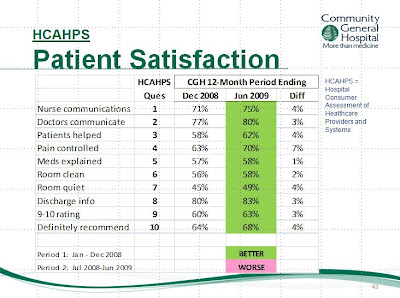
I discussed patient satisfaction and showed how Community's most recent HCAHPS scores – as self-reported by Medicare patients – have improved in every category.

The HCAHPS survey measures the percentage of Medicare patients who report that nurses and doctors “always” communicate well, that their pain is “always” well-controlled, and that their rooms are “always” well-cleaned. Community does well in comparison with other Syracuse hospitals – we have the highest scores in three of ten categories and the second highest scores in another five categories. And . . . Community's HCAHPS scores improved in the most recent 12-month period (see the chart, below).
Improvements to come

I talked about improvements being made to patient rooms on several units. The sixth floor renovation (orthopedics) has been completed, and room improvements are underway on Three West. Furthermore, we have begun to update rooms on Four West and, when finished in late summer, the patients and staff from Two West will relocate to Four West to take advantage of the updated and larger rooms. Following that, we will make improvements to the GYN rooms on Two East.

The new health information exchange

Community will become the first hospital in Syracuse this year to link to the health information exchange (HIE) being developed by the Health Advancement Collaborative of Central New York (HAC-CNY).

The HIE will initially link all four Syracuse hospitals, through the Internet, with five primary care physician groups, representing several hundred physicians. By next year doctors and hospitals on this fledgling network will be able to exchange patient-specific data with the consent of the patients themselves. As more physician practices join the exchange, HAC-CNY will link to other networks through the State Health Information Network of New York (SHIN-NY). The idea is to make individual patient information readily available to any of that individual’s caregivers. Naturally, there are demanding security and patient privacy requirements for this to function.

Employees had a number of questions and suggestions during the meetings, and I appreciated the opportunity to speak with so many of you.

Saturday, April 24, 2010

The ink was barely dry

The ink on the new healthcare legislation was barely dry before, it seemed, the trade press was full of new information about its impact.

Quoting a report from Moody's, HealthLeaders Media said last week that "healthcare reform is a long-term net negative for the not-for-profit hospital sector because it will effectively reduce revenues to hospitals." The report, as referenced, is Long-term Credit Challenges of Healthcare Reform Outweigh Benefits for Not-for-Profit Hospitals.

A posting on the website of health care financial executives, hfma, said the "reform legislation will squeeze savings out of Medicare and increase regulatory oversight for private insurers, resulting in more difficult negotiations with commercial and managed care payers. Many not-for-profit hospitals will struggle. . . "

Two weeks ago an article in the New England Journal of Medicine took an ominous look at the untenable growth of federal debt in the light of health care reform. In "The Specter of Financial Armageddon -- Health Care and Federal Debt in the United States," NEJM said, "Growth in health care spending in one of the primary contributors to increases in (federal) debt over the long run, so the long-term strategy must involve slowing the growth."

The ratio of debt to gross domestic product (GDP) was 53% in the US last year. "Economies can bear substantial debt . . ." according to the NEJM authors, "but there is a limit to how high debt can rise and still be financed without causing serious economic harm." The debt-to-GDP limit set by the European Union is 60%, although some European countries exceed that and some experts apparently claim that a 90% ratio is OK. The authors report the trend of federal income and expense suggests the US will blow past a 90% debt-to-GDP ratio by 2020. "[O]ur structural debt places us on a path of debt growth that is unsustainable," they say, "largely because of health care programs."

Last week HANYS, New York's hospital association, predicted the impact of health care reform over a ten-year period for each hospital in the state. It's a stark picture. The health care reform legislation is expected to reduce New York's hospital revenues by $13.5 billion over the period.

There are 26 hospitals in the Central New York region, including four in Syracuse. The total impact in Central New York, according to HANYS, will be a negative $910 million. That affects 26 hospitals at an average $34.7 million reduction each (again, over ten years). If anything, this may be understated since the combined impact of the Patient Protection and Affordable Care Act and the Health Care and Education Affordability Reconciliation Act will be phased over a number of years.

Because of healthcare reform, Community General is expected to receive $36.3 million less, according to the HANYS model. The total reduction for the four non-federal Syracuse hospitals is estimated at $425.1 million.

HANYS has not estimated the increased revenues hospitals would receive because more patients are expected to have health insurance as a result of health care reform. There is, as yet, no forecast of that additional revenue, but it is hard to believe it could offset the magnitude of lost revenue -- or even come close.

The health care reform legislation has many parts, and its impact will be felt in many ways over the coming years. This much seems pretty clear: the legislation will be transformative.

Friday, August 14, 2009

Reforming the system

Suppose we want to reform the transportation system. Where would we start?

Would we begin with bridge repairs, fuel costs, or alternative energy? Would we consider incentives or taxes on rail, ship, airline or truck traffic? How would we reduce accident rates – by changing vehicle design or operator behavior? What about licensing criteria or insurance costs? Could we address the comparative value of different modes of transportation? What percentage of the nation's economy should be devoted to transportation?

The reform analogy, of course, applies to the "health care system." It sounds straightforward enough, but reforming the "health care" involves many different sectors – industries in themselves, really – sectors that function in technical ways and involve a web of risk, referral, production, regulation, and financing connections.

This is why the advocates (and opponents) of health care reform talk about so many different things. There are many things.

Consider:

▪ Extending insurance coverage to the uninsured ("access,” “universal health care,” and "the public option"),
▪ Aligning financial incentives involving doctors and hospitals ("quality improvement," "patient safety," and "efficiency"),
▪ Controlling the cost of government entitlements ("affordability"),
▪ Paying for additional coverage by taxing employer-paid health insurance benefits ("affordability"),
▪ Mandating insurers to cover preexisting conditions ("access"),
▪ Authorizing payments only for services proven to be clinically effective ("review board," "rationing" and "affordability"),
▪ Limiting the resources used by individuals in the final six months of life ("quality of life," "rationing," and "affordability"),
▪ Expecting lawmakers to use any public plan they create for others ("fairness" and "quality"),
▪ Increasing payments for primary care specialists ("access"), and
▪ Developing better ways to manage chronic conditions ("prevention" and "affordability").

The list goes on.

It's no wonder people are talking past one another. It is no wonder people are concerned about the feasibility of trying to do so much all at once.

Saturday, August 1, 2009

The r-word

The r-word is not “reform” as in health care “reform.” It’s health care “rationing.”

An argument for explicit rationing was made by Peter Singer in a recent New York Times Magazine (July 19). A Princeton professor and native Australian, Singer says the US should establish a treatment effectiveness review board to decide if Medicare (or any national payment system) should cover costs associated with specific medical tests and treatments.

On July 23 Peter Orszag, the White house budget director, was quoted in the New York Times as saying America needs “an independent commission that would measure the efficiency of specific medical providers and practices.”

Just the other day in the Wall Street Journal (July 30), there appeared an op-ed article by Myrna Ulfik, arguing against such a federal health review board. Ms. Ulfik, a cancer patient, said that to survive she must have “the freedom to choose my insurance, my doctors, and get the diagnostic scans and care I need.” Implicit in the freedom to choose, of course, is the ability to commit a government (or other third party) to paying the cost associated with such choice.

Ms. Ulfik argues that a government commission should not limit an individual's health care decision-making. Poignantly she says, "I am still here because my care was managed by doctors — not a government agency. My doctors do what the bureaucracy can’t: They see me as a human being.” By still "here" Ms. Ulfik means still "alive."

Ms. Ulfik's argument accords with that of the rabbi, as quoted by Dr. Singer: “if you put one human life on one side of a scale, and you put the rest of the world on the other side, the scale is balanced equally.”

"Patient-as-person will be a lost concept under the new health-care plan," writes Ms. Ulfik, "where treatments will be based not upon individual patient needs, but upon what's best for everyone."

Dr. Singer asserts that the government already weighs human life in economic terms. The Department of Transportation, he says, "sets a limit on how much it is willing to pay to save one human life. In 2008 that limit was $5.8 million." He cites a similar value set by the Consumer Products Safety Commission. I have written about the value of life in a previous post.

How does one balance the appraising decision-making of Dr. Singer against Ms. Ulfik's moral imperative? Interestingly, such decisions may depend upon the part of the brain that’s doing the thinking.

Josh Green, a Harvard professor, has studied how the brain “lights up” under MRI examinations when individuals consider specific moral questions, such as how to balance the good of many against an individual good.

Dr. Green says moral decisions apparently emanate from different brain regions. When the ethical choice is, in effect, an accounting exercise (the greater good for the greater number, as in Dr. Signer’s argument), the brain reaches its decision in the region “behind the eyebrows.” When the moral problem is resolved by asserting basic human values, the decision apparently comes from deep within the brain, involving older brain structures that we share with our primate cousins. Dr. Green talked about this in 2006 on a WNYC radio science show called Radio Lab.

Considered morally, an individual life may have infinite value. This is how the life is seen by the individual, by the family, and by caregivers. They know, and worry about, and care for the individual person. When considered from the viewpoint of the government, however, a single life may have a finite value.

The government's job is to achieve the best results from limited resources. That is why it can train and send soldiers in harm's way. That is why it can set limits on health care spending. What are those limits? That is what the debate about health care reform is all about.